
 Language
- No.101 Wanbo 1st Road, Nancun Town, Panyu District, Guangzhou, Guangdong, China
- 0086-020-84886013,84886093,84886091,84886012
- sales@finegosteel.com
- Complaints & Suggestions : suggest@finegosteel.com


Product News
How Can You Select the Perfect Steel Elbows for Pipe Projects?
Sourcing the right fittings for a massive construction project is stressful. If you choose the wrong specifications, you face installation delays and budget overruns. I will help you solve this today. Steel elbows for pipe are essential fittings used to change fluid direction in a system. They usually come in 45, 90, and 180-degree angles. Choosing the right elbow depends on the connection type, radius, and material to ensure safety and efficiency in your pipeline.
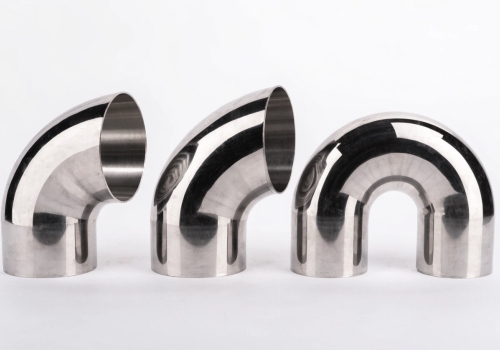
You might think all elbows are the same, but the small details make a huge difference. I want to share my experience to help you avoid mistakes. Please read the following sections carefully.
What Are the Differences Between Butt Weld, Socket Weld, and Threaded Connections?
Many purchasing managers feel confused when they see different connection codes on a BOM list. If you buy the wrong end type, the site engineers cannot install them. Butt weld elbows suit high pressure, while socket weld and threaded elbows work best for small diameters. Knowing the difference ensures your steel elbows for pipe fit perfectly and hold pressure safely.
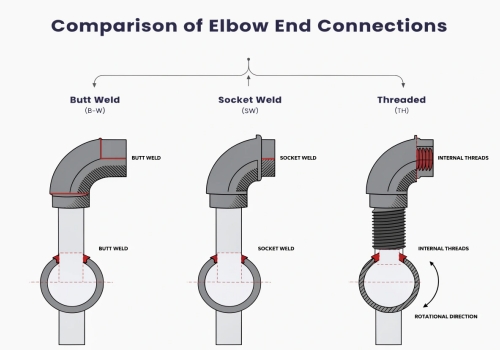
I have been in this industry for a long time, and I see connection mistakes happen often. The connection type decides how strong the pipeline is. The most common type is the Butt Weld (BW) elbow. We weld the end of the elbow directly to the pipe end. This is very strong. It handles high pressure and high temperature well. If your project is for oil or gas, you likely need this. The two ends have a bevel to make welding easy. Then we have the Socket Weld (SW) elbow. This is different. The end of the elbow has a ladder shape inside. You insert the pipe into this area. The diameter of this "ladder" area matches the pipe's outer diameter. You weld it on the outside. This is very good for small diameter pipes. It makes the welding work fast and simple. Finally, there is the Threaded elbow. It looks like the SW elbow, but the inside has threads. You screw the pipe in. This is great if you need to take the pipe apart later for maintenance. It is simple to install, but we do not use it for very high pressure. Here is a simple table to help you compare them:
| Connection Type | Best Used For | Installation Method | Pressure Handling |
|---|---|---|---|
| Butt Weld (BW) | Large pipes, Critical lines | Direct welding (Beveled ends) | High |
| Socket Weld (SW) | Small pipes, Permanent lines | Insert and Fillet Weld | Medium/High |
| Threaded | Small pipes, Maintenance areas | Screwing (No welding) | Low/Medium |
When Should You Use Long Radius Versus Short Radius Elbows?
Space on a construction site is always limited, but fluid flow needs room to move smoothly. You must balance the physical space against the efficiency of the pipeline system. Long radius (LR) elbows reduce friction and are the standard choice. Short radius (SR) elbows fit in tight spaces. Your choice affects the flow rate and pressure inside the steel elbows for pipe.
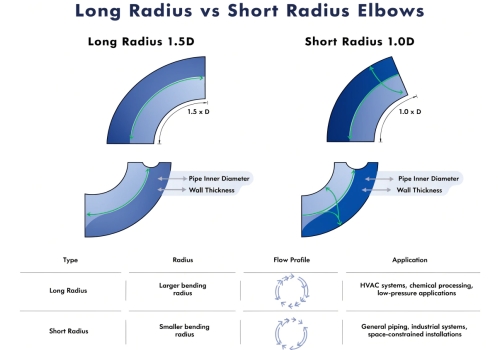
When we talk about radius, we talk about the curve of the elbow. This is very important for the flow of water or oil inside. I always tell my clients to check if the drawing says LR or SR. LR means Long Radius. The radius is 1.5 times the diameter of the pipe. For example, if the pipe is 4 inches, the radius is 6 inches. This is the standard. It gives a smooth turn. The friction is low, and the liquid moves easily. If the buyer does not say what they want, we usually supply LR elbows. SR means Short Radius. The radius is equal to the pipe diameter. So, a 4-inch pipe has a 4-inch radius. The turn is very sharp. This sharp turn creates turbulence and pressure drop. So, why do we use it? We use it when there is no space. Imagine a tight corner in a ship or a crowded factory. You must use SR elbows there. You also need to know about "Reducer Elbows." Sometimes, you need to change direction and change pipe size at the same time. This fitting does both jobs. It saves space because you do not need a separate reducer and an elbow. It makes the design cleaner.
How Do Angles and Material Grades Impact Project Longevity?
Replacing a corroded or broken fitting is expensive and stops production. You need to select the right material and angle from the start to ensure the project lasts for decades. Common angles are 45, 90, and 180 degrees. Material selection, like Carbon or Stainless Steel, dictates the lifespan of the fitting in harsh environments. This is critical for steel elbows for pipe.
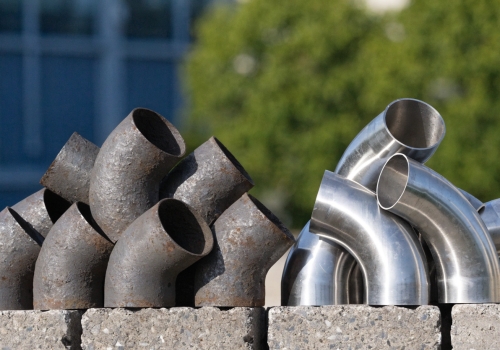
First, let's talk about angles. The 90-degree elbow is the king. It is everywhere. It connects vertical pipes to horizontal pipes. It fits perfectly with steel structures. The 45-degree elbow gives a softer turn. We use it to reduce friction. Then there is the 180-degree elbow, or "return bend." This turns the fluid completely back. You see this often in heating coils or heat exchangers. Now, material is the most critical part for purchasing. At Finego Steel, we see two main categories. First is Carbon Steel. Common standards are ASTM A234 WPB. This is strong and cheap. We use it for oil, gas, and structural projects. It usually has a painted surface to stop rust during shipping. Second is Stainless Steel. This contains Chromium and Nickel. Common grades are 304 and 316. It does not rust easily. If you are building a food factory, a chemical plant, or an offshore platform, you need this. It costs more, but it lasts much longer. We also have Alloy Steel for very high temperatures or pressures. The manufacturing process matters too. We use the "Mandrel method" for most seamless elbows. We push a heated pipe over a horn-shaped core. This makes the wall thickness even. For large sizes, we might weld steel plates together. As a purchasing manager, you must check if the manufacturer follows ISO and ASTM standards. This ensures the chemical composition is correct.
Conclusion
Choosing the right elbows saves time and money. You must consider the connection type, radius, and material. At Finego Steel, we provide high-quality integrated solutions for your projects.
- No.101 Wanbo 1st Road, Nancun Town, Panyu District, Guangzhou, Guangdong, China
- 0086-020-84886013,84886093,84886091,84886012
- sales@finegosteel.com