
 Language
- No.101 Wanbo 1st Road, Nancun Town, Panyu District, Guangzhou, Guangdong, China
- 0086-020-84886013,84886093,84886091,84886012
- sales@finegosteel.com
- Complaints & Suggestions : suggest@finegosteel.com


Industry News
What Are Friction Losses Through Pipe Fittings and How Do They Affect Your System?
Are you tired of unexpected pressure drops in your piping system? This hidden problem wastes pump energy and costs money. Understanding friction is the key to solving this issue completely. Friction losses through pipe fittings refer to the decrease in fluid pressure and flow rate caused by the resistance inside elbows, valves, and tees. This resistance forces pumps to work harder, which reduces operational efficiency and increases energy costs for your construction projects.
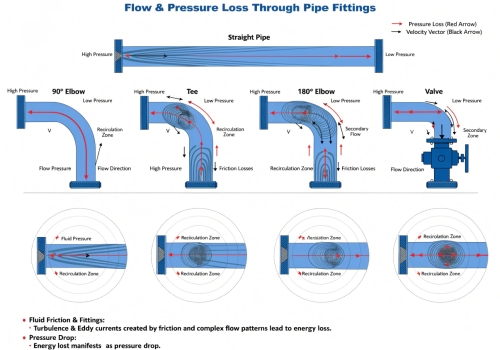
You might think that straight pipes are the only parts you need to worry about. However, I have learned from my 18 years in the construction industry that small connections often hide the biggest problems. Let us look closer at what really causes these energy drains so you can stop them.
Why Does Corrosion and Scaling Cause Pressure Drop in Pipelines?
Do your old metal pipes look clean on the outside but perform poorly? Internal rust eats away at your system. Let us explore why dirty pipes ruin your flow rates. Corrosion creates rough internal surfaces that catch the fluid and slow it down. Over time, ions react with the metal to form hard scaling. This buildup shrinks the inside diameter of the pipe, directly increasing the friction and causing a massive pressure drop.
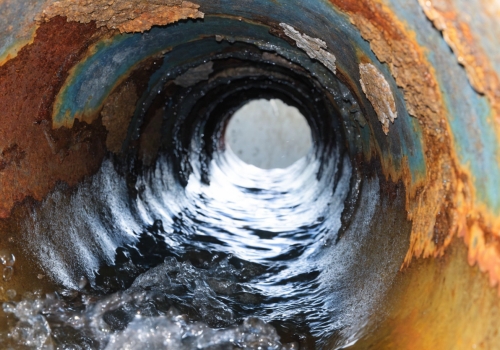
How Build-Up Ruins Smooth Operations
When I first started sourcing materials for EPC contracting companies, I did not pay much attention to the inside surface of the pipes. I only looked at the price. I quickly learned a hard lesson. One of our major water projects failed because the internal walls rusted within two years. Many industrial processes use hard water, acidic chemicals, or slurries. These harsh liquids attack the metal. They cause pitting and rough spots. When bacteria find these rough spots, they stick to the metal and form a biofilm. This biological layer makes the pipe even narrower. When the inside of the pipe becomes rough or narrow, the fluid has to fight harder to move forward. This directly adds to the system resistance. You must check the material compatibility before you design a system. If you choose the wrong material, you will face high maintenance costs. Below is a simple table showing how different conditions affect the inside of your pipes:
| Problem Type | Main Cause | Effect on Pipe Flow |
|---|---|---|
| Corrosion | Acidic fluids reacting with metal | Creates a rough surface |
| Scaling | Mineral buildup on walls | Makes the inside diameter smaller |
| Biofilm | Bacteria sticking to rough areas | Adds soft resistance layers |
| Pitting | Abrasive slurries wearing the wall | Causes local turbulence and damage |
How Can You Calculate Friction Losses Through Pipe Fittings?
Are you guessing the right size for your valves and elbows? Guessing leads to buying pumps that are too big. You need exact math to size your piping network correctly. You can calculate friction losses through pipe fittings by finding the equivalent length of a straight pipe that gives the same resistance. Engineers often use the Hazen-Williams formula to find the friction head loss. This method helps you pick the right pump size for your project.
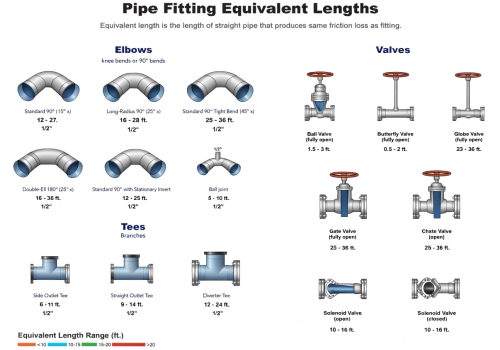
Using Equivalent Length for Better Design
I used to spend hours looking at CAD drawings, trying to figure out why the water pressure was too low at the end of the line. I realized I was ignoring the elbows and tees. Every time fluid changes direction, it loses energy. We measure this energy loss by comparing the fitting to a piece of straight pipe. The Hazen-Williams formula is the standard tool we use. It uses a "C-Factor" to measure how smooth the pipe material is. A higher C-Factor means the pipe is smoother. For example, a new, high-quality steel pipe has a good C-Factor, but a rusted pipe has a very low one. When we calculate the pressure drop, we must include the resistance from all the bends and valves. Here is a basic table showing the C-Factor for common materials. A higher number means less friction:
| Piping Material Type | Average C-Factor Value | Surface Smoothness Level |
|---|---|---|
| Smooth Thermoplastics | 150 | Very High |
| New Carbon Steel | 120 | Good |
| Old Rusted Cast Iron | 90 | Poor |
| Cement Lined Steel | 140 | High |
By converting your elbows and tees into "equivalent lengths" of straight pipe, you can find the total system resistance. This step is vital to avoid buying extra-large pipes or pumps, which helps you save a lot of money for your company.
How Do You Optimize Piping Systems to Reduce Energy Waste?
Do high energy bills hurt your project budget? Bad pipe layouts force pumps to work at maximum power. You can fix this by making smarter choices during the design phase. You optimize the system by selecting high-quality materials that resist corrosion and scaling over time. You should also design layouts with fewer sharp bends. This strategy lowers the friction losses through pipe fittings, allows you to use smaller pumps, and reduces your total project costs significantly.
Smart Sourcing for Long-Term Success
In my early days as a buyer, I thought buying the cheapest pipes was the best way to save money. I was wrong. The engineers showed me that cheap pipes rust quickly. When pipes rust, the friction goes up. To fix the low flow, we had to buy bigger, more expensive pumps. The energy cost of running those huge pumps erased all the money we saved on the cheap pipes. To truly optimize a system, you must think about the whole life of the project. You need to balance the pipe size, the flow speed, and the material quality. Some designers try to push fluid faster through small pipes to save money upfront. However, fast fluid creates more friction and wears out the metal faster. Here is a table showing the impact of your design choices:
| Design Choice | Initial Cost Impact | Long-Term Operational Cost |
|---|---|---|
| Using larger pipe sizes | Higher | Much Lower (saves pump energy) |
| High fluid velocities | Lower | Much Higher (needs big pumps) |
| Many sharp 90-degree elbows | Standard | High (huge pressure drops) |
| High-quality smooth fittings | Slightly Higher | Very Low (keeps flow steady) |
Working with CAD tools helps me see where I can remove unnecessary bends. But the most important step is finding a reliable supplier. You need a partner who provides consistent, high-quality parts that fit together perfectly. This reduces the rough edges at the joints and keeps the fluid moving smoothly.
Conclusion
Minimizing friction saves energy and money. As your reliable one-stop supplier, Finego Steel offers high-quality pipe fittings designed to keep your systems running smoothly and efficiently for years.
- No.101 Wanbo 1st Road, Nancun Town, Panyu District, Guangzhou, Guangdong, China
- 0086-020-84886013,84886093,84886091,84886012
- sales@finegosteel.com