
 Language
- No.101 Wanbo 1st Road, Nancun Town, Panyu District, Guangzhou, Guangdong, China
- 0086-020-84886013,84886093,84886091,84886012
- sales@finegosteel.com
- Complaints & Suggestions : suggest@finegosteel.com


Product News
What Are the Critical Physical Properties of API 5L Line Pipe?
Date:2026-02-24
Buying the wrong pipe grade for a pipeline project can lead to catastrophic pressure failures and massive budget overruns. You need to understand the specific physical properties to ensure safety and cost-efficiency. API 5L line pipe physical properties are defined by their grade, which correlates to minimum yield strength in kilopounds per square inch (ksi). Standard grades are A and B, while high-strength grades use X followed by the ksi value (e.g., X60). These properties determine pressure capacity and suitability for oil and gas transmission.
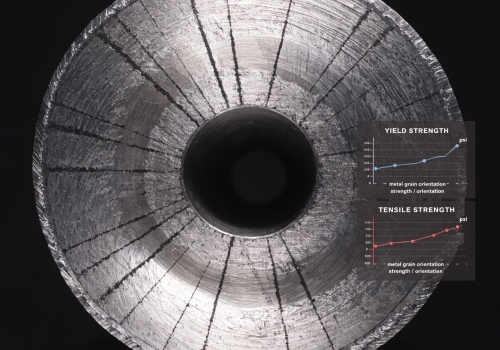
I often see confusion among procurement teams regarding these numbers. It is not just about picking a random grade. It is about matching the steel's behavior to your project's environment. Let's look closely at how these grades work.
How Do We Decipher API 5L Line Pipe Grade Designations?
Seeing "X52" or "X70" on a supplier quote can be confusing if you do not know the underlying code. This confusion often leads to either over-engineering the project or, worse, dangerous under-specifying. The grade designation indicates the steel's strength. Grades A and B are standard, while "X" grades represent stronger steel. The number following the "X" is the minimum yield strength in ksi. For example, X60 has a minimum yield strength of 60,000 psi.
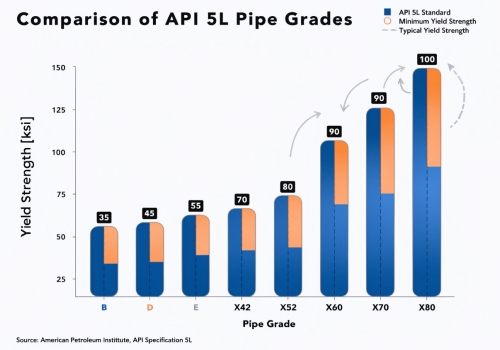
When I help clients at Finego Steel, I always start with the basics of these designations. The "Yield Strength" is the point where the metal stretches and will not return to its original shape. The "Tensile Strength" is the point where the pipe actually breaks. In the api 5l line pipe specification, the logic is straightforward. If you see Grade A, it is the softest. If you see X80, it is incredibly strong steel used for high-pressure transmission. Here is a breakdown of the standard grades we supply. I have organized this based on the physical properties found in the API Spec 5L.
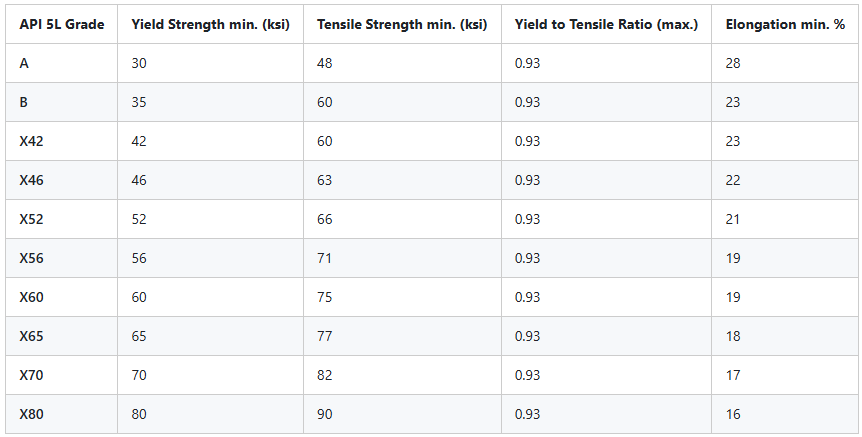
You will notice a pattern in the table. As the yield strength goes up, the elongation percentage goes down. This means stronger steel is generally less ductile. This trade-off is crucial.
At Finego Steel, we have handled projects requiring ultra-high strength X80 pipes for long-distance transport. We also supply standard Grade B for urban low-pressure lines. The choice depends on your design pressure. If you choose X42 instead of Grade B, you get stronger pipe. This might allow you to use a thinner wall thickness. Thinner walls mean less weight. Less weight means lower transport costs. This is where a good purchasing strategy can save money.
Does Standard API 5L Testing Cover All Applications?
Many buyers assume a standard mill test report covers every possible scenario and safety requirement. This assumption can leave you with pipe that fails in cold weather or cannot be used in specific equipment assemblies. Standard API 5L mechanical testing often omits Reduction of Area (RA) and Charpy V-Notch (CVN) reporting. If you need pipe for API 6A equipment or low-temperature service, you must request these specific tests separately to ensure the material can withstand brittle fracture and high stress.
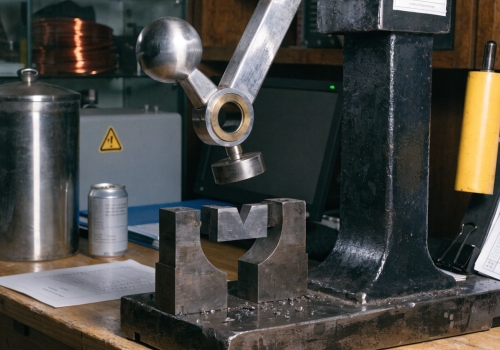
I need to emphasize a specific limitation here. The standard requirements for api 5l line pipe focus on yield and tensile strength. They do not automatically force the manufacturer to check for everything. Specifically, the "Reduction of Area" (RA) measurement is often omitted. Why does this matter? If you are building equipment under API Spec 6A, you have strict rules. If the yield strength is above 36 ksi (which includes almost all X-grades), you cannot use the pipe body material unless you have RA data. If you buy standard pipe without asking for this, you cannot use it for those applications without expensive retesting. Another gap is the Charpy V-Notch (CVN) test. This test measures toughness. It tells you how the pipe handles sudden impacts, especially in the cold. Standard API 5L specs do not always mandate this. If you are sourcing pipe for a project in a freezing environment, like a northern pipeline, you need high toughness. If you buy standard pipe, it might be brittle in the cold. It could crack. At Finego Steel, we ensure these tests are done when the customer's application demands it. We do not want you to face a failure on site. Here is a simple checklist for when to ask for extra testing:
· Low Temperature Service: Must ask for Charpy V-Notch (CVN).
· Sour Service (H2S environment): Must ask for hardness testing and specific chemical limits.
Can You Swap ASTM A106 with API 5L Line Pipe?
Suppliers often say these pipes are the same to close a sale quickly when stock is low. However, treating them as identical without checking the Mill Test Report is a risky move that can violate engineering standards. While ASTM A106 and API 5L specifications overlap, they are not automatically interchangeable. Variations in chemical composition and testing requirements mean a pipe might meet one spec but not the other. Always verify dual certification on the Mill Test Report before substituting.
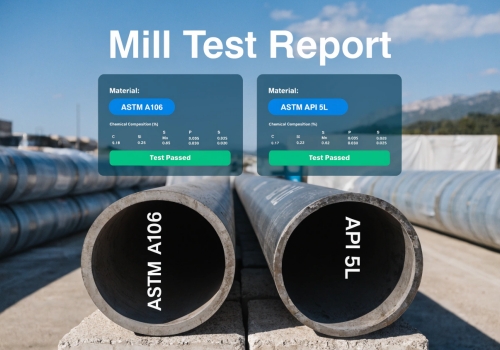
This is perhaps the most common question I get. A customer asks for api 5l line pipe, and a trader offers ASTM A106 Grade B instead. They say, "It is the same thing." It is not. ASTM A106 is designed for high-temperature service. API 5L is designed for the transportation of oil and gas. They have different goals. The chemical requirements are different. The mechanical tests are different. For example, API 5L requires more specific testing on the weld seam if it is welded pipe (though A106 is usually seamless). API 5L also has stricter controls on the carbon equivalent in higher grades to ensure weldability in the field. A106 focuses on how the material holds up under heat. However, there is a middle ground. Many steel mills produce pipe that meets both standards. This is called "Dual Certified" pipe. The stencil on the pipe will read something like "API 5L Gr B / ASTM A106 Gr B". If you find dual certified pipe, you are safe. You can use it for either application. But you must never assume. You must look at the Mill Test Report (MTR). I have seen cases where a client bought A106 pipe thinking it would work for a gas line. The field inspectors rejected it because the paperwork did not state API 5L compliance. This caused a massive delay. At Finego Steel, we check these overlapping specs for you. We confirm if the inventory is dual certified. We ensure the MTR explicitly states the grades you need. We understand that paperwork is just as important as the steel itself.
Conclusion
Understanding the physical properties of grades A, B, and X-grades is vital for pipeline safety. You must look beyond the basic yield strength and consider elongation, specific testing like CVN, and the differences between ASTM and API standards. We at Finego Steel are ready to help you navigate these technical details for your next project.
- No.101 Wanbo 1st Road, Nancun Town, Panyu District, Guangzhou, Guangdong, China
- 0086-020-84886013,84886093,84886091,84886012
- sales@finegosteel.com
We use cookies and other tracking technologies to improve your browsing experience on our website, to show you personalized content and targeted ads, to analyze our website traffic, and to understand where our visitors are coming from,This behavior is in compliance with the user consent policy.