
 Language
- No.101 Wanbo 1st Road, Nancun Town, Panyu District, Guangzhou, Guangdong, China
- 0086-020-84886013,84886093,84886091,84886012
- sales@finegosteel.com
- Complaints & Suggestions : suggest@finegosteel.com


Industry News
UOE vs JCOE: Which LSAW Pipe Forming Process Fits Your Project?
Date:2026-11-12
You receive two pipe quotes. One says UOE, the other JCOE. Choosing the wrong UOE vs JCOE option can ruin your budget. Let us clear up this confusion. UOE and JCOE are both reliable methods for making longitudinal welded pipes. UOE shapes plates in large, single steps, making it perfect for huge, standard orders. JCOE bends plates in small, progressive steps, offering great flexibility for custom sizes and smaller batches.
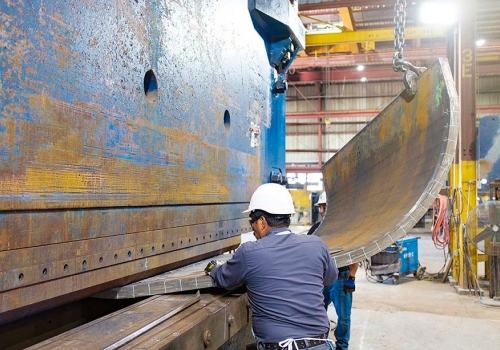
Do not let confusing factory terms slow down your purchasing decisions. Keep reading to find out exactly how these two methods impact your bottom line and site installation.
How Do UOE and JCOE Forming Processes Actually Work?
UOE and JCOE bend plates differently. Factory acronyms look like a secret code. If you do not understand the machine steps, you cannot verify the factory capability. UOE uses massive presses to force a steel plate into a U-shape, then an O-shape in two quick hits. JCOE takes a slower approach, pressing the plate edge-to-edge into J, C, and O shapes through dozens of small bends.
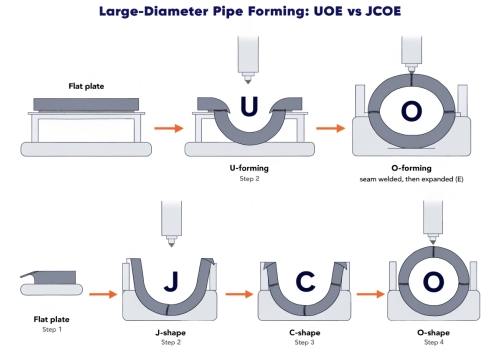
To really understand the difference, we need to look at the factory floor. When I visit a pipe mill, the speed difference is obvious. UOE lines run fast. They are huge machines built for high output. JCOE lines move slower but handle strange sizes easily.
UOE process steps
· Second, a giant press forms the whole plate into a U shape.
· Third, another press closes it into an O shape.
· Finally, the factory welds and expands the pipe.
JCOE process steps
· The machine presses one half of the plate into a J shape.
· It flips the plate and presses the other half into a C shape.
· It closes the middle to make an O shape.
· The factory welds and expands the pipe. Here is a simple data breakdown of what this means for your order:
| Feature | UOE Route | JCOE Route |
|---|---|---|
| Production speed | Very fast | Slower |
| Size flexibility | Low | High |
| Tooling cost | High | Low |
| Best match | Long pipelines | Custom projects |
Why Does Production Volume Matter for UOE vs JCOE?
Volume dictates your choice. Small orders often face rejection from big mills. Paying for unnecessary minimum order quantities (MOQ) kills your budget. You must choose carefully. UOE lines require massive setup times, making them cost-effective only for orders over thousands of tons. JCOE lines have low setup costs, so they happily accept small, mixed-size orders without demanding huge price penalties from buyers.
Cost control is the biggest headache for any purchasing manager. I have seen buyers force a small order into a UOE mill, only to pay massive setup fees. You do not want to make that mistake. The machine type directly changes your invoice.
Hidden costs in pipe orders
· Minimum steel plate rolling requirements from the steel mill.
· Scrap material during the first test runs.
· Destructive testing limits per batch. If your project needs 50 kilometers of standard 36-inch pipe, UOE wins easily. The high speed drops the price per meter. But if you need 500 meters of a strange heavy-wall pipe for a pump station, UOE mills will not even quote you. JCOE mills will take that job quickly. You also must watch the steel plate minimums. Sometimes the JCOE mill agrees to a small order, but the steel plate supplier demands a 500-ton minimum heat. Always ask your supplier what exactly drives the MOQ. We help our clients check plate availability first to avoid these hidden traps.
How Do UOE and JCOE Handle Heavy Wall and Geometry Controls?
JCOE handles thick walls better. Site workers hate pipes that do not line up. Bad pipe ends slow down welding. You need strict shape control. Both UOE and JCOE use mechanical expansion to lock in the final roundness. For extreme heavy-wall pipes, JCOE often performs better because its step-by-step pressing handles thick steel easier than a single massive UOE press.
A pipe might pass the factory test but fail at your construction site. When two pipes have slightly different oval shapes, your welders spend hours trying to match them. This problem usually starts at the forming and expansion stage. The letter E in both UOE and JCOE stands for expansion. The factory pushes a tool inside the welded pipe to stretch it slightly. This step removes stress and makes the pipe perfectly round.
Site fit-up risk factors
· Wall thickness variations at the pipe ends.
· Springback effect in high-strength steel.
· Damage during loading and transport. When you buy heavy-wall pipes, JCOE has a distinct advantage. The progressive bending force concentrates on a small area, pushing thick plates easily. UOE presses must push the entire 12-meter plate at once. If the plate is too thick, the UOE machine simply lacks the power. I always ask factories for their pipe-end measurement maps from past orders to prove they can control the shape.
Frequently Asked Questions
Q: Can JCOE pipes match the quality of UOE pipes?
A: Yes. Quality depends on plate material, welding control, and expansion, not just the bending method. Both methods meet strict API and EN standards.
Q: Which forming method offers a faster delivery time?
A: It depends on your order size. For massive orders, UOE is faster due to high output. For small or custom orders, JCOE delivers faster because setup takes less time.
Q: Does the forming route affect the pipe price?
A: Yes. UOE is cheaper per ton for huge volumes. JCOE avoids high setup fees, making it cheaper for short runs and odd sizes.
Conclusion
Both UOE and JCOE produce excellent pipes, but matching the method to your volume and size saves money. Finego Steel provides top-tier pipeline solutions—contact us today for reliable quotes!
- Prev : Customer Final Inspection of Prefabricated Pipe Spools: Centerway Steel Ensures Secure and Reliable Delivery
- Next : No matching information found
- No.101 Wanbo 1st Road, Nancun Town, Panyu District, Guangzhou, Guangdong, China
- 0086-020-84886013,84886093,84886091,84886012
- sales@finegosteel.com
We use cookies and other tracking technologies to improve your browsing experience on our website, to show you personalized content and targeted ads, to analyze our website traffic, and to understand where our visitors are coming from,This behavior is in compliance with the user consent policy.